Barzakh
A Sufi teaching on the threshold within — the isthmus between worlds that, the tradition says, we do not visit occasionally but always already stand in.
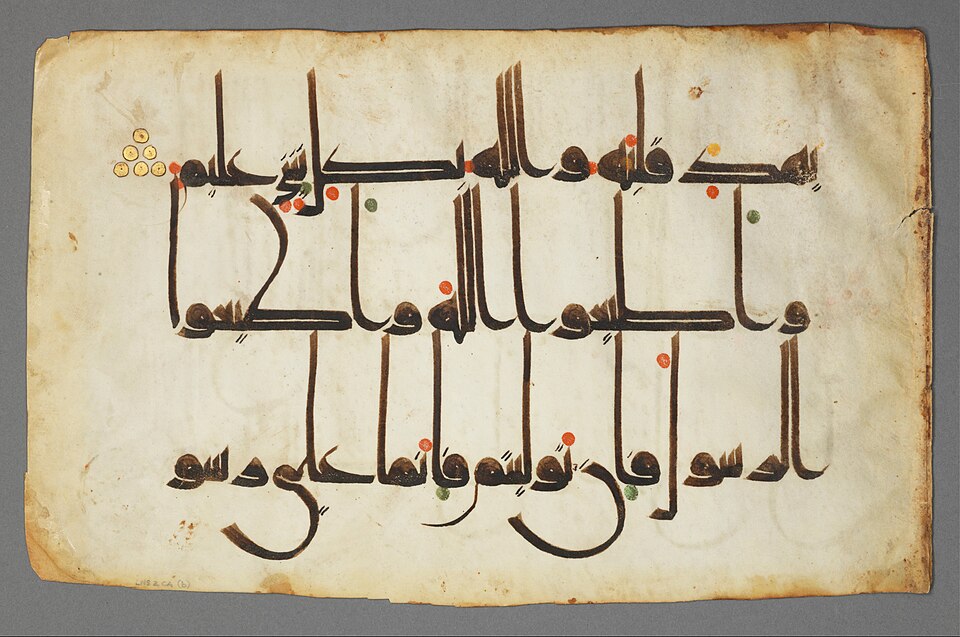 Qur’an folio in Kufic script, Surah Al-Mu’minun 23:99–100 — the passage naming the barzakh: “and behind them is a barrier until the Day they are resurrected”
Barzakh (“isthmus,” or “barrier”) is the Qur’anic and Sufi term for a threshold that both separates and joins — the interval between death and resurrection in the Qur’an (23:100), and, in the metaphysics Ibn Arabi built on that term, every intermediate zone where two orders of reality meet: spirit and matter, dream and waking, the human being itself. It is the same threshold this issue keeps returning to under other names.
The piece below is a video, “The Sufi Barzakh Threshold: Where Divine Meets Reality,” from the YouTube channel SpiritualRelief, together with its transcript. The video closely follows a Substack essay, “Between Worlds: The Barzakh Principle in Sufi Cosmology and Experience,” credited to a named writer, James Fleming, who states he works from original translation of primary Sufi texts in Arabic, Persian, and French. But it remains unverified at the level that matters most for citation: the essay attributes direct quotations to Ibn Arabi, Rumi, Shabistari, and other historical Sufis without naming an edition, translator, or page for any of them.
We present it here as an evocative, well-organized synthesis of real Sufi cosmology, not a scholarly source to cite a specific Sufi master’s exact words from. Readers who want to quote Ibn Arabi or Rumi with confidence should trace the passage to a proper edition first.
Transcript
The human reality is itself a barzakh between divine and cosmic realities, between absolute and relative being. To know oneself as this threshold is the beginning of wisdom.
Not this, not that, yet both this and that. In Sufi cosmology, reality is not composed of separate independent realms, but exists as a continuous spectrum with subtle thresholds between different states of being. The Arabic term for this in-between realm is barzakh, literally meaning isthmus or barrier — a liminal space that both separates and connects different orders of reality.
The barzakh is not merely a theoretical concept but describes a fundamental principle operating throughout existence. You know it as that moment before sleep, thoughts transforming into images, logic dissolving into dreams, your mind suspended between worlds — or during deep creative flow, when you’re simultaneously most yourself yet least confined by your usual identity.
These thresholds exist everywhere: the shoreline, neither land nor sea; twilight, neither day nor night. Consider that instant of recognition when seeing a face, but before naming who it is; the space between inhale and exhale in meditation; the uncanny feeling in elevators or stairwells; that strange suspended moment when music peaks and time seems to pause. We inhabit these in-between spaces constantly — in airports and hotel lobbies, in the pause before making a decision, in the shift between roles throughout your day, in the experience of déjà vu.
What exactly makes these moments so distinctive, so charged with potential? Why do they feel simultaneously unsettling and revelatory? The Andalusian Sufi master Ibn Arabi described it as something that separates two things while never lacking the qualities of both. This principle offers profound insight into the nature of human consciousness itself, which the Sufi tradition recognizes as inherently liminal, existing precisely at the meeting point of multiple worlds.
In Sufi cosmology, the universe is understood not as a collection of discrete objects but as degrees of manifestation of a single reality. The barzakh represents the crucial interfaces between these different levels of being. The most fundamental barzakh in Sufi cosmology exists between the absolute unmanifest divine essence and the manifest cosmos. This primary threshold allows for creation itself, creating a space where manifestation can occur without compromising divine transcendence. As the Persian Sufi poet Mahmud Shabistari wrote: “Between absolute non-existence and absolute existence stretches an isthmus where all the mysteries of the world are contained.”
Another crucial barzakh exists between the spiritual and material realms — not as a hard boundary, but as a permeable membrane, allowing interchange and communication. The 13th-century Sufi master Ibn Arabi elaborated an entire metaphysics based on this understanding. The world of imagination, ‘alam al-khayal, serves as an intermediate realm between the spiritual world of pure meaning and the material world of sensory forms. This imaginal realm has distinct characteristics: it is less dense than matter yet more substantial than pure spirit; it contains forms like the physical world, yet these forms are malleable like thought; it follows its own laws, differing from both spiritual and physical principles. As Ibn Arabi explained, in the imaginal realm subtle bodies become corporealized while dense bodies become spiritualized.
The isthmus is not somewhere we occasionally visit, but where we always already exist.— from the transcript
The barzakh between life and death received particular attention in Sufi teaching. Rather than seeing death as an absolute end, Sufis understood it as a transformation of consciousness from one state to another, with the deceased entering an intermediate state before final resurrection. This “life of the grave” (hayat al-qabr) represented a distinct order of existence — neither the material life of the world nor the purely spiritual life of paradise, but a state with qualities of both.
These cosmological barzakhs were not merely theological speculations but provided a framework for understanding how different orders of reality interact and communicate. The Sufi tradition taught that the human being, uniquely positioned at the meeting point of multiple worlds, could become consciously aware of these thresholds and even learn to navigate them.
In Sufi anthropology, the human being represents the quintessential barzakh, existing at the intersection of spiritual and material realms, embodying qualities of both. The 12th-century Persian Sufi Ayn al-Qudat Hamadani described humans as amphibious beings, able to live in both the ocean of spirit and on the land of matter. This intermediary position gives humans a unique cosmic function: to serve as conscious bridges between realms. Ibn Arabi wrote: “The human being is the barzakh between necessity and possibility, between absolute and relative, between eternity and time.” This perspective transforms human identity from a fixed entity to a dynamic threshold where different orders of reality meet and interact.
Three aspects of human nature particularly exemplify this barzakh quality. First, consciousness itself functions as a barzakh between inner and outer worlds. The Persian Sufi tradition described awareness as the meeting point where the objective world is processed through subjective experience. As the 13th-century Sufi Najm al-Din Razi observed, consciousness is neither fully objective nor fully subjective, but the threshold where both meet and transform each other.
Second, the heart, qalb, serves as a barzakh between spiritual perception and embodied experience. The Arabic word qalb connotes both the physical heart and the spiritual center of the person. Sufis understood it as the organ that translates spiritual realities into embodied understanding, and conversely transforms bodily experiences into spiritual insight. As Rumi wrote: “The heart is the isthmus where body and spirit exchange their secrets.”
Third, the creative imagination functions as a barzakh between abstract meaning and concrete form. The Sufi tradition developed sophisticated practices involving active imagination, khayal, as a way of accessing the intermediate realm where meanings take form and forms reveal meaning. The 12th-century Persian Sufi Ruzbihan Baqli described this faculty: “The imagination stands between pure intellect and sensory perception, allowing each to participate in the other’s nature.”
These aspects of human nature as barzakh were not merely philosophical concepts but formed the basis for specific spiritual practices aimed at developing conscious awareness of one’s threshold nature. The goal was not to transcend the barzakh condition, but to fully embody it with awareness — to become what Ibn Arabi called the complete human being, who knows themselves as the conscious meeting point of multiple worlds.
The Sufi tradition recognized various states of consciousness that exemplify the barzakh principle — liminal states that partake of multiple orders of reality simultaneously. These were not merely subjective experiences but genuine modes of perception, giving access to intermediate realms.
Dreams represented the most universal barzakh state of consciousness. Sufis understood dreaming not as mere subconscious processing but as a shift in the mode of perception that allowed access to the imaginal realm. The 10th-century Sufi master al-Hakim al-Tirmidhi taught that in dreams the soul partially detaches from sensory preoccupation, allowing it to perceive the intermediate world where meanings appear as forms. Dreams thus served as natural thresholds between ordinary and non-ordinary perception.
Specific spiritual states, ahwal, manifested the barzakh quality through their intermediary nature. The state of bewilderment, hayra, highly valued in Sufi practice, was understood as a barzakh between knowing and unknowing, where certainties dissolve but new perception has not yet crystallized. As Ibn Arabi noted, bewilderment is the station between intellectual knowledge and direct witnessing, partaking of both while being neither.
The state of expansion, bast, represented a barzakh between individual and universal consciousness, where personal awareness remains intact while simultaneously participating in broader reality. The 9th-century female Sufi Rabia al-Adawiyya described this state: “The heart expands until it contains what cannot be contained, yet without ceasing to be itself.”
These barzakh states of consciousness were cultivated through specific practices. The Kubrawi Sufi order developed techniques for what they called “waking dream consciousness” (ru’ya fi’l-yaqza) — maintaining awareness of both ordinary and non-ordinary perception simultaneously. The Persian master Najm al-Din Kubra instructed: “Learn to perceive the imaginal forms while remaining fully awake in sensory awareness, for this threshold perception reveals the unity underlying apparent multiplicity.”
The highest spiritual states were understood as perfect embodiment of the barzakh principle: the state of annihilation in God and subsistence through God, fana and baqa, represented the ultimate threshold consciousness, where individual identity is simultaneously transcended and fulfilled through participation in divine reality. As the Persian Sufi Bayazid Bistami expressed it: “I disappeared into my disappearance and became manifest through my disappearance.”
These barzakh states were not considered escapes from reality but deeper engagements with its multidimensional nature. The Sufi tradition taught that everyday consciousness itself is inherently liminal, always operating at the threshold between different dimensions of being — but that this liminality becomes conscious and intentional through spiritual development.
The Sufi tradition developed specific practices for cultivating awareness of the barzakh principle in everyday experience — ways of perceiving and engaging with the thresholds present in ordinary life. The practice of witnessing, mushahada, involved perceiving the imaginal dimension within physical reality. The Persian Sufi tradition taught techniques for seeing beyond the apparent solidity of material forms to the subtle realities they manifest. As the 12th-century Sufi Abu Madyan explained: “Look at created things until you see through them to what they reveal. The outer form is a veil, a threshold, and a revelation simultaneously.”
The practice of “presence between presences” (hudur bayn al-hudurayn) developed the ability to maintain awareness of multiple dimensions simultaneously. The 14th-century North African Sufi Ibn Ata’illah described this practice: “Train yourself to be present with both the visible and invisible aspects of any situation, neither neglecting physical reality nor ignoring subtle dimensions.”
The practice of “standing at the isthmus” (wuquf al-barzakhi) involved cultivating comfort with in-between states rather than seeking resolution in one direction or another. The Andalusian Sufi tradition emphasized this practice for developing spiritual maturity. Ibn Arabi taught: “The one who knows reality stands at the isthmus, embracing apparent contradictions without forcing them into premature unity.”
These practices were not merely psychological techniques, but ways of aligning human consciousness with the fundamental structure of reality as understood in Sufi cosmology. As the Persian Sufi poet Mahmud Shabistari wrote: “The universe itself exists in a barzakh condition. By realizing our own barzakh nature, we come into harmony with the essential nature of reality.” The contemporary Turkish Sufi teacher Cemalnur Sargut observes that these practices have particular relevance in our time: modern humans suffer from fragmenting reality into irreconcilable opposites — mind versus body, science versus spirituality, individual versus community. The barzakh perspective offers integration without reducing the uniqueness of each pole.
The Sufi understanding of barzakh offers profound resources for contemporary questions about consciousness, identity, and reality. Three applications stand out as particularly relevant.
First, the barzakh perspective offers a framework for understanding liminal experiences that fall outside conventional categories. Contemporary interest in phenomena like hypnagogia (the threshold state between wakefulness and sleep), flow states where self-consciousness and action merge, and various altered states of consciousness reflects an intuition that threshold experiences reveal important aspects of reality. The Sufi tradition provides a sophisticated framework for understanding these not as anomalies, but as glimpses of the intermediary realms that exist throughout reality.
Second, the barzakh principle offers insight into the nature of symbols and symbolic thinking. In contemporary discussions, symbols are often reduced to either mere subjective associations or concrete representations of abstract concepts. The Sufi understanding of the imaginal realm as a barzakh between pure meaning and sensory form provides a more nuanced approach, recognizing symbols as genuine thresholds where meaning and form, invisible and visible, interpenetrate.
Third, the barzakh perspective offers a framework for integrating apparently contradictory aspects of human experience. Contemporary lives often involve navigating between seemingly incompatible domains — professional versus personal, intellectual versus emotional, individual versus communal. The Sufi understanding of human consciousness as inherently liminal suggests that integration comes not from resolving all tensions, but from developing the capacity to stand consciously at the threshold between different dimensions of experience.
These applications extend beyond explicitly spiritual contexts. As the contemporary Sufi teacher Kabir Helminski observes, the barzakh understanding is not only mystical but practical — it develops the capacity to navigate complexity without reducing it to false simplicity, a crucial skill in our interconnected, multidimensional world.
The Persian Sufi tradition emphasized that barzakh awareness is not an esoteric achievement but the birthright of human consciousness itself. As Rumi wrote: “You are not a drop in the ocean. You are the entire ocean in a drop.” This paradoxical statement expresses the quintessential barzakh nature of human identity — simultaneously finite and infinite, particular and universal, form and essence.
The Sufi understanding of barzakh ultimately points toward a way of being that embraces threshold consciousness as our natural state rather than an exceptional condition. The isthmus is not somewhere we occasionally visit, but where we always already exist. Ibn Arabi wrote in his masterwork, the Fusus al-Hikam (The Bezels of Wisdom): “The human reality is itself a barzakh between divine and cosmic realities, between absolute and relative being. To know oneself as this threshold is the beginning of wisdom.”
This perspective transforms spiritual development from a journey toward some distant goal into an increasing awareness of what we have always been — conscious meeting points where different dimensions of reality converge and communicate. The Persian Sufi poet Hafez expressed this realization: “I am a hole in a flute that the Christ’s breath moves through. Listen to this music.”
As we cultivate awareness of these thresholds, we discover what the Sufi tradition has always taught: that intermediary realms are not merely transitions between real places, but constitute the most fertile ground of reality itself. The barzakh is not a boundary to cross, but a place to stand, to perceive from, and ultimately to recognize as our truest home. In the words of Mawlana Rumi: “Out beyond ideas of wrongdoing and rightdoing, there is a field. I’ll meet you there.”
“The Sufi Barzakh Threshold: Where Divine Meets Reality.” SpiritualRelief (YouTube), published May 9, 2025. https://www.youtube.com/watch?v=VgmJvEYojo0. Closely follows James Fleming, “Between Worlds: The Barzakh Principle in Sufi Cosmology and Experience,” Spiritualrelief (Substack), October 28, 2025.