More Than Unity
A close reading of Psalm 133 in the Entered Apprentice initiation.
Behold, how good and how pleasant it is for brethren to dwell together in unity! It is like the precious ointment upon the head, that ran down upon the beard, even Aaron’s beard: that went down to the skirts of his garments; As the dew of Hermon, and as the dew that descended upon the mountains of Zion: for there the Lord commanded the blessing, even life for evermore.
Psalm 133, King James VersionInitiatory riddles, like oracular riddles, are a tricky affair. Interpreting them rightly and misinterpreting them are a world apart. But they have rules. The first is that if something immediately strikes you as the right solution, then it’s the wrong one. They are highly deceptive — not because they deceive us but because they create the opportunity for self-deception. They play on our weaknesses; flatter our desire to come up with quick answers; bring out the worst in us as well as the best.
Peter Kingsley, In the Dark Places of Wisdom1The almost common, and accepted reading of Psalm 133, among those who encounter it in the context of the Entered Apprentice initiation, is that it is a psalm about unity. And there is a reason for this: the first line says so, plainly and beautifully. Behold, how good and how pleasant it is for brethren to dwell together in unity. Of course, the idea of unity is the first thing that Masons, or for that fact, any fraternity would grab on to. The very definition of fraternity is unity!
But clinging on to that idea of unity, then, tends to color everything that follows in its light. The anointing oil becomes a symbol of unity. The dew of Hermon becomes a symbol of unity. The blessing of life evermore becomes, somehow, a symbol of unity. Simply put, that reading is the wrong one. Not because unity is absent from the psalm — it is present, in the first verse — but because it is only the first verse of three, and, perhaps, the least important of them. That is the warning of Peter Kingsley in his quote about initiatory riddles. To reduce the psalm to its opening line is to fall into exactly the self-deception Kingsley describes: accepting the first answer because it is satisfying and never asking what the rest of the text is doing there. Anyone familiar with esoteric teaching knows that the easy path is likely the wrong one.
The founders of the modern Masonic ritual were learned men — scholars, clergymen, philosophers, men who read Greek and Latin and who were intimately familiar with the whole of scripture and the traditions that surrounded it. When they placed this psalm at the moment of circumambulation in the EA degree, they were not reaching for a pleasant sentiment. They were invoking a complex of ideas about consecration, priesthood, sacrifice, and the promise of eternal life — ideas that the three verses of Psalm 133 contain in miniature, and that the initiation itself enacts in form.
I. The Songs of Ascents
Psalm 133 belongs to a collection of fifteen short psalms running from Psalm 120 to Psalm 134, known collectively as the Songs of Ascents — or, variously, the Gradual Psalms, the Songs of Degrees, the Pilgrim Songs. The Hebrew title, Shir HaMaalot, means simply a song of going up, and the collection is associated with the practice of pilgrimage to Jerusalem for the three great festivals of the Jewish year: Passover, Shavuot, and Sukkot. Tradition holds that these were the songs sung by the Israelites as they made their way toward the Temple Mount.
Within the Temple itself, the Levites — the priestly tribe charged with the service of the sanctuary — sang these same psalms while ascending a flight of fifteen semicircular steps into the inner court. The number was not incidental. In sacred architecture and liturgy, number carries significance, and the fifteen steps corresponded precisely to the fifteen psalms of the ascent. Each step was, in this sense, a degree. The language is not accidental, and a Freemason reading this description will notice the resonance immediately.
Among those who established the ritual practices of the English lodges in the late seventeenth and early eighteenth centuries were men for whom such correspondences were a matter of serious study. The two earliest known members of Masonic lodges in England — Sir Robert Moray (1609–1673, initiated in 1641) and Elias Ashmole (1617–1692, initiated in 1646) — were also founding members of the Royal Society and were deeply versed in alchemy, Hermeticism, Rosicrucian philosophy and well versed in holy scripture. When they and their contemporaries reached for a text to accompany the circumambulation of the altar in the EA initiation, they reached for one they had read with care. The phrase due and ancient form, still present in the ritual, was not a formulaic pleasantry. They knew exactly what it meant.
II. What the Hebrew Bible Says
The standard reading of the opening verse — behold, how good and how pleasant it is for brethren to dwell together in unity — treats it as a general statement about fraternal harmony. Modern biblical scholarship, however, offers a more precise interpretation. The word translated as brethren designates not simply friends or companions but members of a group, or all Israel. And the phrase to dwell together is in fact a legal term: it refers to joint tenancy of undivided land holdings, the arrangement by which brothers who inherit a property hold it in common without partition.
Used metaphorically here, the verse is better understood — as the Jewish Study Bible and other modern commentaries argue — as a hope for the reunification of the Northern and Southern Kingdoms of Israel, divided since the death of Solomon and not restored when the psalm was likely written. The brethren dwelling together are the two estranged halves of a single nation. The image is not sentimental but political and prophetic, the hope of a people that has been split and longs to be whole.2
This broader reading is reinforced by the geography of the third verse. Mount Hermon stands at the far northern tip of the land of Israel; Mount Zion lies at its southern heart. The dew descending from Hermon to Zion covers the entire extent of the country — from north to south, from the separated kingdom of Israel to the kingdom of Judah. The blessing of unity encompasses the whole. It is a vision of a fractured people restored.
The new candidate brought into the lodge is, in some sense, enacting this same restoration. He enters as a stranger; he is received into brotherhood. A body that was incomplete becomes whole. The circumambulation — the movement around the altar while the psalm is recited — is not merely ceremonial. It inscribes the candidate within a circle that is now closed.
III. The Anointing of Aaron
The second verse, “It is like the precious ointment upon the head, that ran down upon the beard, even Aaron’s beard: that went down to the skirts of his garments,” moves from the social to the sacred. The image is not of oil in general, but of the anointing oil poured upon the head of Aaron at the moment of his consecration as the first High Priest of Israel — an oil of a particular composition specified in Exodus 30:22–33: myrrh, cinnamon, calamus, cassia, and olive oil, blended according to divine instruction. This is not perfume. It is a substance set apart for a single purpose, never to be used for anything else.
The account of Aaron’s consecration in Leviticus 8:5–12 is worth reading in full, because the ritual described there is an initiation in every meaningful sense. Moses brings Aaron and his sons forward and washes them with water. He dresses Aaron in the sacred vestments: the tunic, the sash, the robe, the ephod, the breast piece bearing the Urim and Thummim. He places the turban on his head and sets upon it the gold plate inscribed with the words Holy to the Lord. Then he pours the anointing oil over Aaron’s head.
The oil that ran down Aaron’s beard and fell to the hem of his garments was the outward sign of an inward transformation. An act of consecration by which an individual was set apart — permanently, irrevocably — for the service of the Divine. And Moses, who performed this rite, was a man who had spent forty years as a prince of Egypt, almost certainly initiated into the mystery traditions of one of the most sophisticated priestly civilizations the ancient world produced. When he consecrated Aaron, he was performing an initiation according to a form that had deep roots.
Anointings in Israel were not reserved for priests alone. Kings were also anointed. Saul was anointed by Samuel; David was anointed by Samuel; Solomon was anointed by Zadok the priest and Nathan the prophet. To be anointed was to be called to a sacred office — and the offices of priest and king, though formally distinct, were in significant ways intertwined. David himself held a priestly role; his sons served as priests. The figure of the anointed one — the Mashiach, the one set apart — was always already a composite: priest and king together.
IV. Consecration and Sanctification
The Masonic initiation contains a prayer spoken by the Worshipful Master over the candidate. It is worth quoting in full, because it is, precisely and formally, a prayer of consecration:
Vouchsafe Thine aid, Almighty Father of the Universe, to this our present convention; and grant that this candidate for Masonry may dedicate and devote his life to Thy service and become a true and faithful brother among us! Endue him with a competency of Thy divine wisdom, that, by the secrets of our art, he may be better enabled to display the beauties of brotherly love, relief, and truth, to the honor of Thy Holy Name. Amen.
Duncan’s Masonic Ritual and Monitor, Malcolm C. Duncan (1866)The structure of this prayer is precisely that of the biblical consecration: an invocation of the Divine, a petition for grace, and a setting apart of the individual for sacred purpose. Hands laid upon the candidate’s head — as they were laid upon Aaron’s — mark the transition from ordinary life to something else.
Consecration refers to an act of the will: a deliberate decision to dedicate oneself to God, to place oneself on the altar as an offering. It is what the candidate does, or more precisely, what is done on his behalf and to which he consents. Sanctification, by contrast, is what God does in response: the ongoing process of transformation, purification, and growth in holiness that follows the initial act of surrender. Consecration is the moment; sanctification is the journey.
When the candidate kneels at the altar — which is called an altar for a reason: it is a place of sacrifice — he is making what the tradition regards as a profound sacrificial offering. Not the offering of an animal, as in the ancient rites, but something more difficult to give and more impossible for any external power to take: his free will. This is the one thing that no omnipotent God can claim, because its value lies entirely in its being freely given. The covenant sworn in the lodge is a sacrament in the original Latin sense: a sacred pledge, a solemn oath, the token of an inward reality. In Latin sacra means holy, and facere means to make. The entire meaning of sacrifice is, sacrificium, to make holy, or to make something sacred through offering it to divine powers.
Yet the nature of this inner sacrifice is subtler than it first appears, and a passage from the Fourth Way tradition sharpens the point considerably. As Gurdjieff once told P.D. Ouspensky:
I have already said before that sacrifice is necessary. Without sacrifice, nothing can be attained. But if there is anything in the world that people do not understand it is the idea of sacrifice. They think they have to sacrifice something that they have. For example, I once said that they must sacrifice “faith”, “tranquility”, or “health.” All these words must be taken in quotation marks. In actual fact, they have to sacrifice only what they imagine they have, and which in reality they do not have. They must sacrifice their fantasies. This is difficult for them, very difficult. It is much easier to sacrifice real things.3
The candidate kneeling at the altar may believe he is offering something he already possesses — his will, his pride, his former self, and these are all true. But Gurdjieff’s insight cuts deeper. At the root of this problem is attachment, or in other words, identification; even our attachment to our suffering must be sacrificed. The fantasies of spiritual attainment, of virtue already achieved, of brotherhood already felt — these are what must be given up before the genuine work can begin. In this light, the covenant taken in the lodge is not the end of a process but the beginning of a far more exacting one. As Gurdjieff put it: he must define exactly what he is willing to sacrifice and not bargain about it afterwards. The altar is not a conclusion. It is a starting point.
V. Priests and Kings
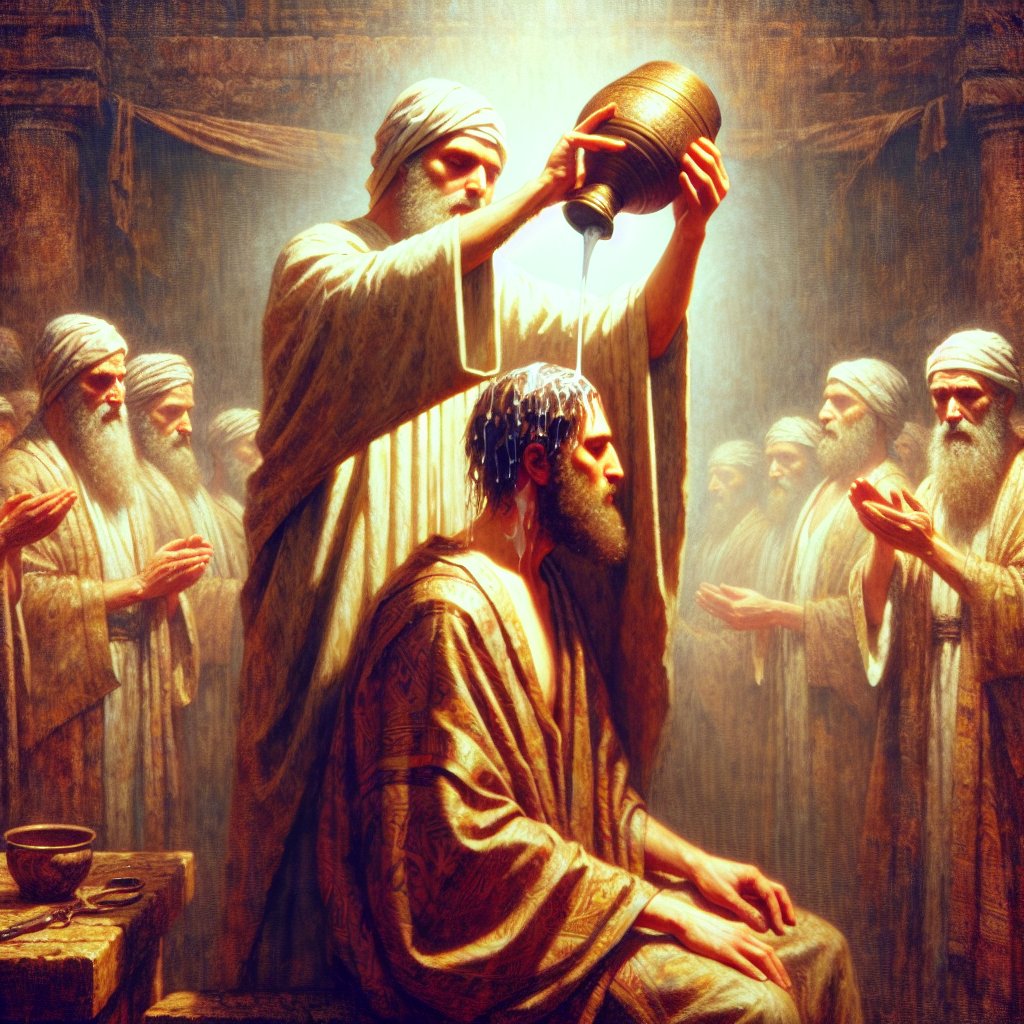 The consecration of the High Priest
The question that the anointing of Aaron necessarily raises is one the initiation implicitly poses without answering in so many words: if the candidate is consecrated by a rite that mirrors the consecration of a High Priest, what does that make him? The answer the tradition offers is contained in the First Epistle of Peter: “But ye are a chosen generation, a royal priesthood, an holy nation, a peculiar people; that ye should shew forth the praises of him who hath called you out of darkness into his marvelous light” (1 Pet. 2:9, KJV). A royal priesthood: both offices held together in a single person, the priest who offers and the king who rules.
The twentieth-century esotericist William G. Gray, founder of the Sangreal Sodality, articulated this idea when he wrote:
Now taking an ordinary soul of our species to be a mixture of human and Divine consciousness, the human part of this combination provides the Priest-component which is willing to sacrifice its ordinary will to that of Divinity. The Divine Lifefactor offers the Kingship-element which wills that humans should be rightly ruled. Thus “Kingship” (or the Blood Royal-GREAL) is of God, and the “Priesthood” is of Man. When that part of ourselves in God which is “priestly” encounters that part of God which is “Kingly” in uS, and the offering or sacrifice is exchanged between these extremities of Existence, then the Grail is being gained.4
The priest approaches the Divine with an offering; the Divine meets the priest as a King, with governance and grace. The exchange between the two constitutes what Gray calls the “gaining of the Grail” — the moment of spiritual enlightenment and immense blessing that the tradition has always placed at the center of the sacred life. The initiation is not merely a ceremony of admission into a fraternal body. It is the beginning of a priestly and kingly vocation. The candidate does not simply join a lodge. He is set apart for something greater.
Nevertheless, it has to be plainly understood that both priesthood and kingship are fundamentally natural abilities of a developing human soul and it is only through their practice that we shall ever attain anything like perfection as a Life-species.5
VI. The Dew of Hermon
The third verse of the psalm completes the movement that the first two began. The image shifts from the anointing oil, which flows downward from head to hem, to the dew of Hermon, which descends from the heights of the north to the mountains of Zion in the south. The parallel is exact: as the oil falls, so the dew falls; as the oil consecrates, so the dew blesses; as the priest is set apart, so the land is refreshed. The two images interpret each other.
For the people of the ancient Near East, dew was not a minor meteorological phenomenon. In a country of long, dry summers where the difference between a good harvest and a poor one could be a matter of life or death, the regular presence of morning dew was a significant mercy. The Jewish liturgy preserved this understanding in the Tefillat Tal, the prayer for dew recited at Passover, which ends: For a blessing, not for a curse. For life, not for death. For abundance, not for famine. Dew was life. Its presence was a sign of divine favor; its absence, of divine withdrawal.
But the dew of Hermon carried a meaning that went beyond agriculture. In Jewish tradition, dew was also the symbol of resurrection. When Isaac lay stunned with terror on Mount Moriah after the binding — the Akedah — it was dew sent by God that revived him, and the angels who witnessed it pronounced the blessing: “Blessed art Thou, O Lord, who quickenest the dead.”6 The prophet Isaiah, writing of the restoration of Israel, used the same image: “Thy dead men shall live, together with my dead body shall they arise. Awake and sing, ye that dwell in dust: for thy dew is as the dew of herbs, and the earth shall cast out the dead” (Isa. 26:19, KJV).
 Morning dew · symbol of divine favor and resurrection in the ancient Near East
The final clause of Psalm 133, “for there the Lord commanded the blessing, even life for evermore,” is not hyperbole or pious sentiment. It is a statement about the ultimate destination of the journey on which the initiation sets the candidate. He is healed of the past by the grace of consecration; he is nourished in the present by the community into which he is received; and he is oriented toward a future that the tradition dares to call life for evermore. The idea of the immortality of the soul was once central to the Masonic understanding of what the degrees were for. The dew is its symbol.
VII. What the Founders Intended
It is impossible to know with certainty what any individual in the early eighteenth century intended by placing this psalm at this moment in the ceremony. We simply cannot know. But it is possible to say with confidence that the men who shaped the Masonic ritual were not working casually. They were scholars who knew their scripture, their classical literature, their Hermetic philosophy, and their history. When they chose Psalm 133 for the circumambulation of the EA initiation, they were not simply reaching for a verse about brotherhood because brotherhood was the theme of the lodge. They were reaching for a text that, read carefully, contains within its three verses the entire arc of what the initiation is meant to accomplish.
The candidate enters as a stranger; the first verse receives him into the brotherhood of Israel, the community of those who dwell together in undivided inheritance. The second verse consecrates him, as Aaron was consecrated, setting him apart for a sacred purpose by an act that has both priestly and royal dimensions. The third verse orients him toward a future of divine blessing, earthly renewal, and the promise of life beyond the visible. Unity, consecration, and eternal life: these are the three movements of the psalm, and they are the three blessings bestowed upon the initiate as has been repeated from times immemorial.
To read it simply as a poem about unity is not wrong. But it is incomplete. It is to stand at the threshold of a very large room and describe only the door.
- 1. Peter Kingsley, In the Dark Places of Wisdom (Inverness, CA: Golden Sufi Center, 1999), 67. ↩
- 2. Adele Berlin and Marc Zvi Brettler, eds., The Jewish Study Bible (Oxford: Oxford University Press, 2004), commentary on Ps. 133:1. ↩
- 3. G.I. Gurdjieff, as recorded in P.D. Ouspensky, In Search of the Miraculous: Fragments of an Unknown Teaching (New York: Harcourt, Brace and World, 1949). ↩
- 4. William G. Gray, Western Inner Workings (York Beach, ME: Samuel Weiser, 1983), 113. ↩
- 5. Ibid., 115. ↩
- 6. Louis Ginzberg, Legends of the Jews (Philadelphia: The Jewish Publication Society, 2003), 1126. ↩
Berlin, Adele, and Marc Zvi Brettler, eds. The Jewish Study Bible. Oxford: Oxford University Press, 2004.
Ginzberg, Louis. Legends of the Jews. Philadelphia: The Jewish Publication Society, 2003.
Gray, William G. Western Inner Workings. York Beach, ME: Samuel Weiser, 1983.
Kingsley, Peter. In the Dark Places of Wisdom. Inverness, CA: Golden Sufi Center, 1999.
Ouspensky, P.D. In Search of the Miraculous: Fragments of an Unknown Teaching. New York: Harcourt, Brace and World, 1949.
Scripture citations follow the King James Version unless otherwise noted. Chicago notes-bibliography style is the citation standard for Alice in Deep.
Keith Idell writes on Freemasonry, scripture, and the Western esoteric tradition. He is a contributing editor to Alice in Deep.