Threshold
A phenomenology of suffering at the edge of language — where the split between subject and object gives way, for a moment, to what John Woodcock calls a meaning event.
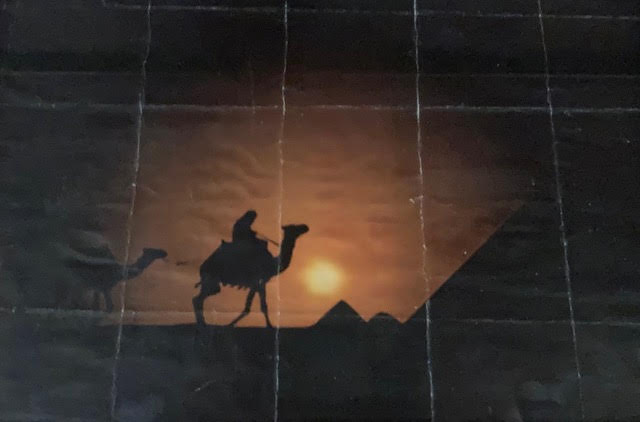 The Nomadic Midnight Wanderer
Buddhism denies the self. One of the capital illusions is “mine”. Buddhism agrees with Hume, Schopenhauer and our Macedonian Fernández. There is a series of mental states. If I say “I think”, I’m making a mistake, because I guess a constant subject and then a work of that subject — i.e. thinking. It’s not like that. I should say, Hume points out, not “I think”, but “I think”, as they say it rains. By saying it rains, we don’t think rain is exercising an action; no, something is happening. In the same way, as they say it’s hot, it’s cold, it’s raining, we must say: think, suffer, and avoid the subject.
Jorge Luis BorgesThe most merciful thing in the world, I think, is the inability of the human mind to correlate all its contents. We live on a placid island of ignorance in the midst of black seas of infinity, and it was not meant that we should voyage far. The sciences, each straining in its own direction, have hitherto harmed us little; but some day the piecing together of dissociated knowledge will open up such terrifying vistas of reality, and of our frightful position therein, that we shall either go mad from the revelation or flee from the deadly light into the peace and safety of a new dark age.1
H.P. LovecraftAs I have written in some of my essays over recent years, there are many streams, or disciplines, that are now joined in the urgent effort of “overcoming” the subject-object divide in our world that has now led us to the precipice.2 There is a general recognition that we are now near or at the point of no return for our species and we may very well take other species with us. And many of these efforts understand that a different way of being is necessary and this way of being may only be found through a transformation in the linguistic foundation of our entire culture in the West. This transformation yields a new style of consciousness, as our artists and visionaries intuit. At the same time our present style of consciousness, our present way of being, our present linguistic world, will be destroyed.
Within this general recognition that we are near a singularity, a point of no return, many are working towards a “linguistic” way (e.g. the “language” of art) to present (not re-present) some hint or gesture of an unknown future lying “beyond” our present linguistic world, and pressing forward or unfolding into actuality. This “beyond” may just as well be called the nothing and I will do so here, along with others, including author John Banville who writes in his novel Newton, as Newton faces the near destruction of his life’s work:
The joke is, it’s not the loss of the precious papers that will drive him temporarily crazy, but the simple fact that it doesn’t matter. It might be his life’s work gone, the Principia itself, the Opticks, the whole bang lot, and still it wouldn’t mean a thing. […] The fire, or whatever the real conflagration was, had shown him something terrible and lovely, like flame itself. Nothing. The word reverberates. He broods on it as on some magic emblem whose other face is not to be seen and yet is emphatically there. For the nothing automatically signifies the everything.3
John Banville, The Newton LetterBanville’s literary style brings me to yet another creative stream concerned with what lies beyond our present consciousness-world configuration (the subject-object split, which I will refer to as S-O). Like many other streams working towards healing our terrible disjunction from any otherness whatsoever, this literary style seeks to approach the nothing linguistically — a near impossibility, since the nothing lies beyond language, beyond our linguistic world.4 This literary effort is not towards describing the nothing — such a move remains within the province of S-O — but, rather towards participation in the production of a meaning event! How are we to understand this literary or artistic effort? Brendan McNamee helps us here by noting:
the ‘event’, the crack that momentarily opens between the saying and the unsaying, is the point at which subject and object coalesce. There is no subject to have an experience, and no object to be experienced; there is simply the event.5
Brendan McNameeThis event occurs at the event horizon or what I call the threshold. My researches took me far and wide into cutting edge systems of knowledge — chaos theory, quantum physics and cosmological physics, calculus, geometry, topology, literature, philosophy — to name a few. I mined these systems in order to appropriate their rhetoric, and my earlier undergraduate studies in physics and maths helped me wade through the complexities of the acquired knowledge in each of the disciplines. I was looking for viable descriptions of the threshold.
I found that the one crucial missing piece in every discipline concerned with thresholds was the key role of suffering. In the epigraph above, Borges alludes to suffering and the threshold: “we must say: think, suffer, and avoid the subject”. By “subject” he means the subject of the S-O split.
My task is to explore how suffering at the threshold or, better, the suffering of the threshold is a key feature in the phenomenology of the threshold — and I mean the soul phenomenology of the threshold. All the cultural practices and disciplines that I mention here are possible only as knowledge is gained from the way the world appears to us as given — and this appearance is determined by soul or the psyche. It is our a priori — the generator of meaning!
Since the world currently appears to us as given in its impenetrable solidity (materialism), we have lost connection with meaning and the generator of meaning — the psyche. Our language has become opaque to depth of meaning because of “the fear of mystification (quite understandable from a scientific point of view), that is, the fear of being taken in unawares by certain unverifiable metaphysical meanings of the notion of soul.”6 This fear leads to
…innumerable meaningless atrocities, all those rapes, assaults, murders that fill our newspapers, but also the books on the history of our time, because we must want a positive reality cleansed of all meaning.7
In response to this embargo on any direct mention of soul/psyche, many disciplines are finding their way to languaging the threshold without using metaphysical language at all.8 Realising that materialism has trapped us inside our language, to the point that whatever lies “beyond” language has the form of an impenetrable black box, many disciplines are nonetheless moving rhetorically “towards the unsayable, towards absence, towards nothingness,” as Brendan McNamee says of Banville’s novels. The point of this collective, century-long effort in literature, art, and philosophy is to address an “extra-linguistic yearning for something, since it must have a word, we may call the sacred.” McNamee defines such efforts as a quest, not to make the unknown known, but to find a way to live in that unknown:
… It is a reaching towards the unknown, but not for the purpose of bringing the unknown into the realm of the known. That has been the way of Western metaphysics. It is more of a quest to find a way to live in that unknown, to breathe the rarefied air of Being. It is in this sense that it bears comparison with mysticism. And also with all true art, whether pre- or postmodern.9
Brendan McNameeThe experience of living with the unknown is possible at the threshold in a soul moment that may be called a meaning event.10 Such a moment “overcomes” the S-O disjunction and could have deep healing effects on the human participant who is in effect participating in an incarnation. Yes, such moments fade or “abscond” but they also leave an imprint in one’s being, generating a life-changing longing and a quest, a way of life that Brendan McNamee describes so well above; or maybe a style of literature by authors such as Banville who tries to move us towards the nothing, or a possible meaning event via his chosen art form.
There is a necessary and difficult preparation, a new cultural practice, if you like, that can promote such a trajectory towards a meaning event and I have been writing about this practice since 1994. Let’s first hear Lyotard’s description of the practice, as quoted by McNamee:
And this is Lyotard on his own idea of the event: “Thus, to encounter an event is like bordering on nothingness. No event is at all accessible if the self does not renounce the glamour of its culture, its wealth, health, knowledge and memory”11
J. F. Lyotard, quoted in Brendan McNameeThis is an extraordinary and daunting claim on our present lives. But it needs to be well understood. Lyotard’s claim finds a kindred spirit in Jung’s notion of a necessary poverty of spirit:
[S]piritual poverty seeks to renounce the false riches of the spirit in order to withdraw not only from the sorry remnants… of a great past, but also from all the allurements of the odorous East; in order to, finally, to dwell with itself alone, where, in the cold light of consciousness, the blank barrenness of the world reaches to the very stars.12
C. G. JungJung here is talking about our modern age of nihilism, the absence in our culture of any living symbols that could collectively bind our lives together coherently. He is not advocating a plan of action — rather a simple owning up to and facing our modern predicament, our empty-handedness. This stance means that we must come down to earth and acknowledge our simple humanness. We need to renounce our outdated metaphysical ideals! This gesture is remarkably hard to achieve. We seem to prefer our ideals and to renounce nothing at all.
John Banville’s literary style valorises the ordinary and some of his beautiful prose even achieves a brief vision of the transfigured ordinary at the threshold:
I recall one Saturday, when she was driving into town to deliver stuff from the nurseries, and I asked her for a lift. It was raining, the fields a speeding blur beyond the misted windows. We were past the village when she took her foot off the pedal and let the car bump slowly to a stop. “Puncture,” she said. But she did not get out. We looked in silence at a wild apple tree shimmering before us in the streaming windscreen. The wheels on my side had climbed the grass verge, and everything was slightly crooked. There was no puncture. A strange moment, I remember it, the rain, the sound of the rain, the worn sticky feel of the car seat. She took off her spectacles, and a strand of hair fell across her face. What was she thinking about? I did not like the way she wore her glasses on a cord, it made her look matronly. An old harridan within me suddenly muttered: She’s forty if she’s a day, and was immediately silenced. A minute went by. I rolled down my window and let in the smell of woodbine and wet earth. Charlotte rubbed the fogged windscreen with a fingertip. “Perhaps we should go back,” she said, and then, looking at my knees: “Edward is not well.” The sibyl had spoken. I nodded, a puzzled priest of the shrine. What was expected of me? Whatever it was I could not give it, and she turned with vague helplessness to the plants and punnets of fruit stacked on the back seat. Her eyes, what colour were her eyes? I can’t remember! She started up the car. We drove on. Thus, always, it would teeter on the brink of being something.13
John Banville, The Newton LetterThis passage is an extended description of the barest, unembellished features of an ordinary afternoon. But the lines “There was no puncture. A strange moment…” initiate a mood of “teetering on the brink of being something.” There is a sudden tension of something imminent about to happen, something pressing, like the prelude of a thunder storm that may or may not break. This is an example of approaching possible meaning events that writers such as Banville and other artists are seeking to convey to us through their art forms. He takes the reader to what I call the threshold — the locus of a possible coming-to-be.
Such moments take us to the edge of what is known (“I did not know what was expected of me”) and we begin to participate in the unknown future as it presses forward into actuality. The primary felt quality of this event horizon is tension, a portent, as I have written elsewhere.14 The degree of felt tension is a qualitative measure of imminence. Something is coming into existence that was not there before. Sometimes it makes it over the threshold, sometimes it recedes back into the nothing.
As Lyotard and Jung suggest, a certain style of living (“spiritual poverty”, the “empty hand”), can prepare us for these meaning events, when they occur, and there is every reason phenomenologically to think of such moments as sacred, as Brendan McNamee reminds us, so that this preparatory cultural practice may be thought of as a sacred path.15 This shift of cultural attention to the threshold is characterized by a corresponding experience of impoverishment, empty-handedness and even abandonment. The threshold is the site of a kind of initiatory suffering, where suffering refers to the process of opening up one’s being to that of the other “beyond” our linguistic categories, sufficiently to receive an imprint, a message that is carved into the matter of the psyche. In one such experience attained in 2010:
I am taken to the Cross where I am slowly nailed to it. Anita knows I am going. I feel the slow penetration of nails. The man slowly inserts one on my chest sideways and draws it through like a sewing needle. Does the same with my left arm bicep muscle. The quality is of relentless, impassive certainty that this is what is happening. I am to endure it. It goes on for some time. There is no sadistic pleasure or horror. It is simply a doing to me! At last I look up and in the blue sky visions break through and I see sacred geometry. Then they are dragging me down the street, and they drop me there, leaving me on the street alone, no help. Abandoned casually as if nothing mattered to them about what happened. They just did their job and are now finished.
We can see in this dream suffering can be understood as an initiatory imprinting. The point is to drive home a message from “beyond” into the being of the initiate, not to punish or torment. Since we are being drawn to the threshold, in order to receive the message, it is incumbent on at least some individuals to stay in the suffering long enough that the message becomes clear. This can take years though, as so graphically illustrated in Kafka’s The Penal Colony:
When the condemned prisoner is lying on the bed, it starts quivering, the harrow sinks onto the body … As it quivers, it sticks the tips of its needles into the body… The condemned person is strapped face down and naked onto the lower section of the apparatus, called the Bed. … A commandment [message — my insert] is artistically engraved onto his body over the course of twelve hours, deeper and deeper, until the process leads to his death. … At first, the condemned person still screamed, and was apt to eat some of the food provided for him. But corresponding to a precisely predetermined procedure, he became quiet around the sixth hour. Now the essential part began. Enlightenment came even to the most dull-witted. But this did not mean that anything extraordinary would have happened, the man simply started to decipher the inscription.16
Franz Kafka, The Penal ColonyThe appearance of sacred geometry at the threshold is the appearance of an ordered (“readable script” by the initiate) movement that is breaking into our current world, with the kind of astonishing, terrifying power and beauty that Rilke knows:
For beauty is nothing but the beginning of terror, that we are still able to bear, and we revere it so, because it calmly disdains to destroy us. Every angel is terror.17
Rainer Maria Rilke, “The First Elegy,” The Duino ElegiesAnd indeed, I had this “pathos” dream in 2004 when I arrived at the threshold, pictured in the dream as a door:
I knocked again and the door opened. A wounded, tattered angel stumbled out into the corridor. He collapsed into my arms and I lowered him gently to the ground. Broken feathers and blood pricked my skin. He seemed mortally wounded and scarcely alive. I turned to Angie who was simultaneously terrified and awe-struck. At the same time she was filled with pity. An old woman followed the angel out into the corridor where he had collapsed in my arms, something like Michelangelo’s Pieta. She said with a voice of great authority, “This is Michael, the archangel of love. Yes, he is nearly dead!”18
This movement at the threshold can be characterised as convolution, deformation, undulation, twisting, contortion — the movement of space-time itself. The human experience of this movement is one of extreme torture, torment, suffering, even agony, as this movement emerges into our present world of static things. Disciplines such as topology combined with computer power, have given us glimpses of such movement but of course it is simulated, positivised movement.19 For example the discovery of chaotic attractors:
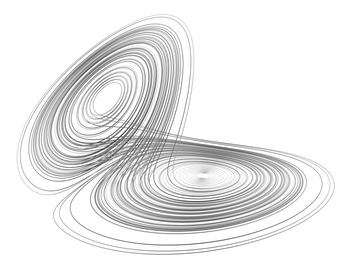 The Lorenz attractor
Such simulations can’t possibly express the human experience of the threshold. My dream shows both human/divine suffering and movement together as the angel, much like Klee’s Angel series. Many artists, writers, poets are pointing to this emergence in their own manner or style. And they are also pointing to the same locus of these strange and astonishingly beautiful appearances.20 Where is this locus or, as Heidegger might say, this “clearing”? John Banville and the Apophatic genre of literature suggest, along with art critic and philosopher Arthur Danto and poet Wallace Stevens among others, that the earthly “site” of the Coming Guest, the unknown future, is none other than each ordinary, commonplace thing, including each of us, as empty hands.21 This locus can become a site for a meaning-bearing soul movement — a threshold that is the overcoming of the subject-object split (S-O) that may occur, even if just for a moment.22
This final de-reification of the Real requires two particular reading strategies: first, to read the Real not as a hard kernel but as some kind of fiction; secondly, to read the Real as ‘a topological twist’ (Žižek and Daly 2004: 78): the inherent curvature of space. We can take these two strategies as the two sides of the ‘parallax view’ of the Real: the kernel is a kind of fiction and our view of ‘it’ is actually the effect of the topological twist.23
Benjamin Noys, on Slavoj ŽižekIn Holbein’s stunning artwork below there is a skull in parallax view, an experience of the Real twisting our stable linguistic world as it enters the threshold.
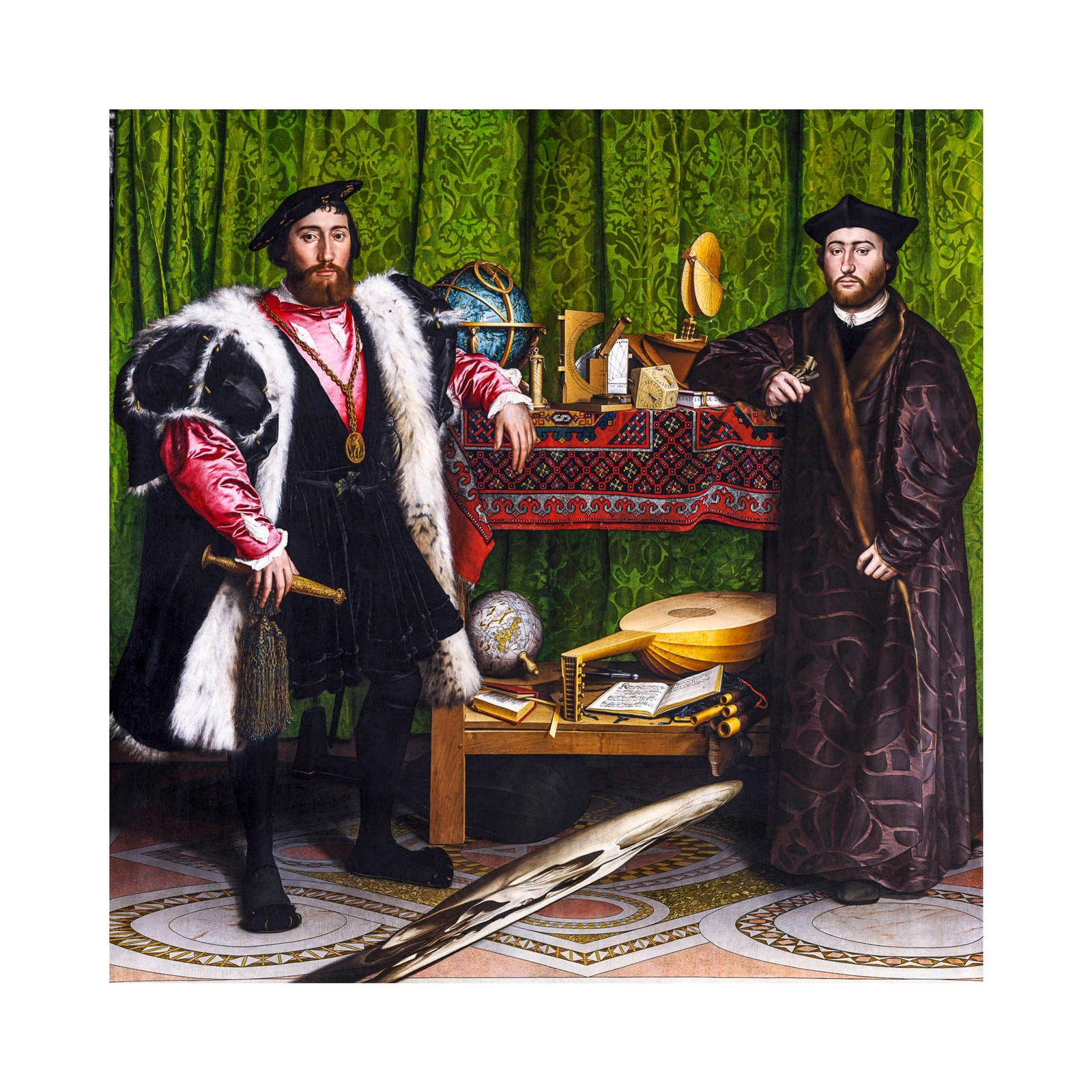 Hans Holbein the Younger, The Ambassadors, 1533
- 1. Lovecraft, H.P. “The Call of Cthulhu,” in The Complete Works of H.P. Lovecraft, Kindle edition. ↩
- 2. See for example the author’s essays at independent.academia.edu/WoodcockJohn/Matter-Future. ↩
- 3. Banville, John. The Newton Letter, in The Revolutions Trilogy, Pan Macmillan UK, Kindle edition. ↩
- 4. A style known as Apophatic — attempting to show the limits of language as well as point to a “real” beyond. ↩
- 5. Brendan McNamee, “The Scandal of the Particular: Tracing the Sacred from Mysticism to Postmodernism in John Banville’s Fiction,” academia.edu/33833441. ↩
- 6. Giegerich, Wolfgang. Soul Violence. New Orleans: Spring Journal Books, 2008, 379. ↩
- 7. Ibid., 161. ↩
- 8. See the author’s essay “The New Materialism and the Rhizome” (2020), academia.edu/42275068. ↩
- 9. Ibid. [McNamee, “The Scandal of the Particular”], 5. ↩
- 10. See the author’s essay “The Gap” (2017), academia.edu/33528147. ↩
- 11. Lyotard, Jean-François. Peregrinations, 18, as quoted in McNamee, 13. ↩
- 12. Jung, C.G. Collected Works, vol. 9i, §29. ↩
- 13. Banville, John. The Newton Letter, in The Revolutions Trilogy, Pan Macmillan UK, Kindle edition. ↩
- 14. See the author’s essay “The 3 and the 4: Emergency of the Unknown Future,” academia.edu/43343770. ↩
- 15. The psyche itself endows the threshold with the highest meaning of the Holy Grail. See the author’s essay “The Grail Mystery for Our Times,” academia.edu/67305042. ↩
- 16. Kafka, Franz. “In the Penal Colony,” in The Works of Franz Kafka, Kindle edition. ↩
- 17. Rilke, Rainer Maria. “The First Elegy,” in The Duino Elegies. ↩
- 18. Incorporated in the author’s short story “Angel Stories for Our Time,” academia.edu/37337475. ↩
- 19. “What Does VR Reveal About the 4th Dimension?” youtube.com/watch?v=S-yRYmdsnGs. ↩
- 20. Fractal geometry shows these strange and beautiful shapes in “phase space.” Their locus is at the boundary between order and random turbulence. ↩
- 21. C.G. Jung’s metaphor for the unknown future; see Letters, vol. 2, 590. ↩
- 22. See Arthur Danto, The Transfiguration of the Commonplace [as cited by the author]. ↩
- 23. Noys, Benjamin. “The Horror of the Real: Žižek’s Modern Gothic.” International Journal of Žižek Studies 4, no. 4. ↩
John Woodcock, born 1950, holds a Ph.D. in Consciousness Studies from Union Institute & University and an M.A. in Counselling Psychology from CSUN. He is the author of twenty-two self-published books exploring the emergence of a new structure of consciousness from within our present one. He lives and works in Sydney, Australia.