Descending to Light
Katabasis in the Masonic Blue Lodge Degrees
How the ancient motif of ritual descent into the underworld illuminates the Entered Apprentice, Fellowcraft, and Master Mason degrees — and what is lost when the depth is forgotten.
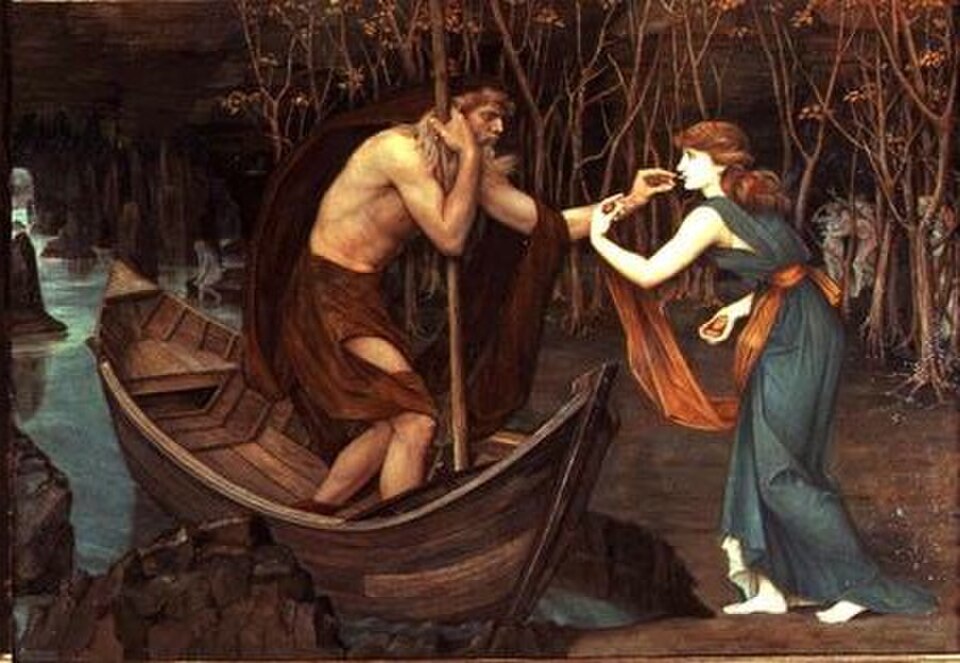 Charon and Psyche · the soul at the threshold of descent
This analysis presumes Freemasonry retains indirect connections to ancient initiatory traditions via archetypal universality and has the capacity to function as a valid initiatic vehicle for psychospiritual transformation — akin to the lesser mysteries, possibly the greater. It distinguishes information from transformation: factual knowledge from wisdom. Regurgitation does not imply inculcation. As Morpheus tells Neo in The Matrix — knowing the path differs from walking it. Without commitment, rituals risk becoming superficial re-enactments. These presuppositions frame the inquiry, acknowledging potential biases toward more esoteric interpretations.
Abyssus Abyssum Invocat. Abyss calls upon Abyss. The perennialist philosopher René Guénon and others posited the idea that “all true initiation requires descent and death.” This paper explores katabasis — a ritual descent into the underworld — as a framework for interpreting Freemasonry’s Blue Lodge Degrees: Entered Apprentice, Fellowcraft, and Master Mason. Integrating anthropology, mythology, and ritual psychology, it identifies katabatic structures manifest in Masonic rituals and practices. While mainstream interpretations emphasize moral allegory, the katabatic lens reveals deeper psychospiritual potential. The analysis underscores the role of ritual in deepening the Masonic experience for the candidate.
“All true initiation requires descent and death.”— René Guénon, perennialist philosopher
I. Katabasis: Definition and Universal Themes
Katabasis derives from the Greek terms kata (meaning “down”) and bainein (meaning “to go”), literally denoting a descent into the underworld or a subterranean realm. From an anthropological perspective, katabasis symbolizes a rite of passage marked by profound liminality, during which initiate, demigod, or deity ventures into a chthonic or otherworldly domain, confronts mortality and existential peril, and acquires knowledge through rigorous trials and ordeals with phases culminating in transformation achieved via symbolic death and subsequent rebirth. This process adheres to a remarkably consistent structural pattern across virtually all ancient cultures. Its antonym is anabasis — the return ascent — which is integral to and completes the katabatic experience.
Drawing upon the foundational works of Arnold van Gennep, Victor Turner, and Mircea Eliade, katabasis reveals consistent structural and archetypal elements that transcend cultural boundaries. These can be organized into three primary phases, each with its own core dynamics, mythological precedents, and Masonic parallels.
| Phase | Core Dynamics | Mythological Examples | Masonic Parallels |
|---|---|---|---|
| I. Separation & Descent | Voluntary ritual death; threshold crossing; leaving the ordered profane world. Stripping away of social identity — names, clothing, and status symbols. | Inanna’s garment shedding (Sumerian); Osiris’s dismemberment (Egyptian); Orpheus’s Styx crossing (Greek); Hermóðr’s Hel ride (Norse). | Chamber of reflection; hoodwink application; cable tow binding; divestment of metals and clothing; entry into lodge guided by Senior Deacon. |
| II. Liminal Trials & Ordeals | Chaos confrontation; encounters with chthonic guardians; exposure to primal opposites (darkness/light, death/life); loss and retrieval of vital essences; visionary revelation. | Isis reassembling Osiris (Egyptian); Persephone’s pomegranate (Greek); Izanagi’s flight (Shinto); Odin’s Yggdrasil hanging (Norse); Mayan Hero Twins in Xibalba. | Circumambulation through darkness; obligation oaths at altar; confrontation with moral tests; working tools as refinement ordeals; the Hiramic Legend. |
| III. Transformation & Reintegration | Rebirth; boon acquisition; esoteric gains (runes, fire, light); assumption of new roles; communal renewal. | Inanna’s return (Sumerian); Osiris as lord of the Duat (Egyptian); Aeneas’s prophetic voyage (Roman); Thor’s Mjölnir (Norse); Buddha’s Dharma (Buddhist). | Hoodwink removal for light reception; apron conferral; northeast corner placement; Hiramic Legend resurrection; acquisition of wages (corn, wine, oil) and new fraternal role. |
Beyond the three phases, certain structural features appear across virtually every katabatic tradition. The threshold cosmology — an inverted mirror of the ordinary world, often conceived as seven to twelve layers — is nearly universal, as is the psychopomp mediator: a ferryman, priest, or ancestral guide who navigates the passage. Number symbolism pervades the experience, particularly the numbers three, five, and seven. Psychologically, the pattern enacts ego death followed by rebirth, shadow confrontation, and visionary gnosis. Cosmologically, the completed katabasis renews not only the individual but the community and the cosmic order itself.
II. Katabasis in Ancient Cultures
Most ancient mythologies exemplify katabasis. In Sumerian lore, Inanna’s seven-gate descent strips the ego layer by layer, confronting death for the sake of resurrection. Gilgamesh’s underwater quest grapples with mortality in search of wisdom. Greek examples are numerous and include Odysseus’s nekyia for prophetic guidance, the twelfth labor of Heracles, and Aeneas’s prophetic underworld voyage as rendered by Virgil. The Eleusinian Mysteries themselves simulated a descent into Hades for afterlife insight, as did most Greek mystery schools. The Latin vocabulary of those rites — catharsis (ritual purification), myesis (lower degrees), legomena (things said), dromena (things done), epopteia (beholding) — maps with striking fidelity onto the language of initiatory Masonry.
In contemporary literature, katabatic motifs continue to thrive, often reinterpreted through the lens of psychological and heroic journeys. Joseph Campbell’s The Hero with a Thousand Faces positions katabasis as a pivotal stage in the monomyth, where protagonists plunge into an abyssal realm, entering the “belly of the whale” to endure transformative trials and emerge with boons that benefit their communities. This framework is evident in Tolkien’s The Lord of the Rings, where Frodo’s harrowing ordeal through Mordor and the Mines of Moria parallels Gandalf’s literal fall into the abyss and subsequent rebirth as Gandalf the White. These modern adaptations preserve and evolve ancient katabatic themes, bridging timeless mythological structures with contemporary storytelling.
III. Katabasis in the Blue Lodge Degrees
Freemasonry’s Blue Lodge Degrees intrinsically embody katabatic themes through their intricate rituals and symbolic elements, even though the explicit term “katabasis” does not appear in standard Masonic literature. Esoteric Masonic scholars from Pike to Hodapp interpret these degrees as incorporating descent motifs that facilitate deep initiatic change, whereas more conventional views frame them primarily as moral allegories devoid of explicit underworld connotations. Our rituals employ a range of tools and symbolic actions to immerse the candidate in a metaphorical underworld characterized by introspection, vulnerability, and trials. Key practices include preparatory contemplation, sensory deprivation, physical restraint, and guided movement — all of which collectively evoke a voluntary, controlled descent into the self and the unknown.
IV. The Chamber of Reflection
The chamber of reflection ideally serves as a dimly lit, austere antechamber where the candidate is left alone prior to the main initiation ceremony, setting the stage for introspection. Typically adorned with a human skull to represent mortality, an hourglass symbolizing the fleeting nature of time, a flickering candle denoting the ephemerality of life, and a cinerary urn evoking decay and the inevitability of death, the room prompts the candidate to respond in writing to philosophical questions about life’s transience, duty, and personal virtues. This solitary prelude immediately precedes the blindfolded entrance into the lodge proper, marking the commencement of the initiatory process.
Functioning as a powerful aid to katabatic descent, the CoR simulates a “descent into the tomb” of the self, akin to the alchemical Negredo — the blackening or dissolution phase that precedes transformation. It enforces isolation, stripping away external distractions and compelling an inward journey of self-examination, much like the mythic hero confronting the shadow self in the underworld. The alchemical acronym V.I.T.R.I.O.L — Visita Interiora Terrae Rectificando Invenies Occultum Lapidem, “visit the interior of the earth; through rectification thou shalt find the hidden stone” — further deepens these katabatic themes. Together the symbolic objects invoke Thanatos, the personification of death, priming the initiate for the symbolic ego death central to katabasis. The Masonic use of the CoR as a ritualized liminal space structurally parallels ancient Egyptian sarcophagus rites and Pythagorean initiatory chambers.
“Internalize that which cannot be externalized. Embody. Become the Chamber.”— On the diminishment of the CoR in American Masonry
Regrettably, the CoR has diminished in usage within U.S. Masonry following the Morgan Affair of 1826, which spurred a period of simplification and public appeasement. As of 2013, the Grand Lodge of Texas explicitly prohibited its use, reflecting broader jurisdictional variations and a shift toward less esoteric practices in certain regions. The recommendation here is simple, and it is addressed to the individual Mason rather than the institution: internalize that which cannot be externalized. Embody. Become the Chamber.
V. Circumambulation
Circumambulation, the ritual act of walking a circular path around the lodge or the sacred altar, draws from a rich tapestry of global traditions: Vedic pradakshina, Islamic tawaf around the Kaaba during Hajj, Celtic and Druidic circling of sacred sites, and Buddhist kora around stupas or mountains. In Freemasonry, the candidate, while blindfolded and secured by the cable tow, performs this movement clockwise — deosil — with periodic stops for oaths, instructions, or symbolic interactions, enabling the brethren to observe and evaluate the candidate’s composure and preparedness. Aspects of the EA catechism imply distinct peril by asking the candidate to “fear no danger” while following his trusty leader.
This dynamic ritual embodies katabatic descent by evoking a spiraling journey into the underworld’s labyrinth, disorienting the candidate and simulating the soul’s wandering through the darkness of ignorance toward enlightenment. Albert Mackey emphasizes its esoteric significance: circumambulation among the ancients was a symbol of the movement of the heavenly bodies, with the sun as solar divine embodiment. Pike concluded that circumambulation and its obstructions refer to the labors and difficulties of progress from darkness to light — aligning with katabatic motifs of navigating chaos to attain divine truth, framing the candidate’s path as a microcosmic journey through zodiacal cycles, cosmic descent, and ultimate ascent.
At its core, circumambulation exemplifies what might be called kinetic embodiment — a ritualistic mode in which deliberate physical motion serves as a conduit for internalizing abstract symbolic or esoteric knowledge. In Freemasonry, this is not mere choreography, but a purposeful ritual designed to anchor the candidate within the sacred space of the lodge, which functions as a microcosm of the universe. Thus it maps cosmic structures onto the candidate’s physical and subtle bodies, inducing altered states of consciousness via sensory modulation and heightening receptivity to the ritual’s obligations and the collective egregore — the group mind or energy — of the lodge and the broader Masonic tradition.
VI. The Hoodwink
The hoodwink, a blindfold placed over the candidate’s eyes during the degrees, acts as a potent katabatic tool by plunging the initiate into a symbolic underworld through sensory deprivation. By eliminating visual perception, it signifies the descent from the illuminated realm of mundane consciousness into the obscurity of the unknown — a quintessential hallmark of katabatic narratives across diverse cultures.
Mackey describes the hoodwink as a “symbol of the secrecy, silence, and darkness in which the mysteries of our art should be preserved” and a “representation of the mystical darkness which always preceded the rites of the ancient initiations.” This echoes mythic descents, like Persephone’s in Hades, forcing reliance on inner senses and guides. In Masonry, it democratizes candidates by equalizing them in vulnerability, fostering humility, trust in the fraternity, and shared intersubjectivity. Its removal signals the anabatic ascent — a revelatory illumination amid divine light and symbols. Rooted in ancient practices such as the Eleusinian blindfolding for entry into the telesterion, it ties Freemasonry to timeless initiatory tradition.
Practically, the heightened auditory and tactile senses induced by the hoodwink strip the visual anchors that ego relies upon, evoking the “dark night of the soul” in which the initiate must navigate perils without ego’s familiar light. The physiology is not incidental: elevated heart rate and cortisol, deepened interdependence, amplified trust in brethren. The descent phase builds resilience against fear for life’s darker trials; the removal marks revelation.
VII. The Cable Tow
The cable tow — placed around the candidate’s neck or body — embodies simultaneous constraint and connection, aligning with katabatic descent-and-return motifs: entry into bondage before liberation. It symbolizes the pre-initiation limits imposed by ignorance and vice, yet also represents the lodge’s guiding path via submission, emphasizing secrecy, humility, and commitment per the EA catechism.
Pike, in Esoterika, describes it as a “hieroglyphic of a pledge or obligation,” denoting bondage to ignorance — removed upon the reception of light and supplanted by moral bonds among brethren and the mystic tie. This duality echoes the myth of Theseus, whose thread through the labyrinth was primarily a navigational aid through peril for safe return, rather than pure restraint. Ritually, its presence induces vulnerability, building trust in guides and encapsulating the confinement-to-release arc that characterizes katabasis in every tradition. Psychologically, it shifts the candidate from external control to internalized allegiance — akin to an umbilical cord in the symbolism of spiritual rebirth.
VIII. Ancillary Elements
Beyond the core elements examined above, ancillary symbols enrich Blue Lodge katabasis, each contributing to the arc of descent, ordeal, and ascent to enlightenment.
The obligation sworn at the altar binds the candidate irrevocably to the Masonic mysteries, akin to crossing the Styx, symbolizing voluntary submission to trials and the symbolic death of old identities for the sake of rebirth. The altar itself, called an altar for a reason, is a place of sacrifice — the lodge’s sacred center where heavenly and earthly realms converge, and esoterically a site of ego sacrifice and gnosis. The northeast corner in which the candidate is placed following initiation signifies rebirth into knowledge and fraternal integration, emblematic of new beginnings at light’s dawn.
The apron, conferred as a talismanic boon following the trials, protects during descent and denotes purity in ascent. Its lambskin material echoes the garments stripped and returned in Inanna’s descent; its triangular flap (divine) over the square body (earthly) unites the two principles in the newly made Mason. The working tools — the gavel to remove ignorance, the square for moral alignment, the compasses for governing desire — aid liminal self-refinement in a manner that parallels Odin’s trials on Yggdrasil, where suffering yields wisdom. And the Senior Deacon, as psychopomp, mediates the descent and ascent as Anubis mediated the Egyptian passage: navigating the uninitiated candidate through chaos toward transformation.
The Hiramic Legend stands apart from all of these as the crown of the Blue Lodge katabatic experience. Hiram’s death at the hands of the three ruffians, his burial, and his raising encapsulates the full katabatic arc: ego annihilation through betrayal (the inner vices), descent into the tomb, and resurrection to wisdom. As Wilmshurst observed, this is the great legend of Masonry precisely because it enacts what the degrees only approximate in symbol — the actual death and resurrection of the initiated self. The Hiramic Legend is Freemasonry’s version of the Osirian dismemberment and renewal, and it is in the Master Mason degree that the katabatic journey reaches its completion.
IX. Conclusion
Katabasis, as a timeless archetype of descent for the sake of enlightenment, is evident throughout Freemasonry’s Blue Lodge Degrees — in the symbols and rituals of the chamber of reflection, the hoodwink, the circumambulation, the cable tow, and most notably the Hiramic Legend. Beyond mere moral lessons, this katabatic perspective uncovers Freemasonry’s profound initiatory heritage. As Wilmshurst affirmed, the degrees constitute “a system of progressive instruction in the science of the soul.”
The distinction between information and transformation is the axis upon which this entire inquiry turns. One can know all of this — the phases, the parallels, the mythological antecedents — and remain precisely where one began. The katabatic framework does not transform the reader. Only the descent does that. What this analysis can offer is an invitation to take the rituals seriously as what they have always claimed to be: not theatrical entertainments, not moral lectures, but a carefully constructed vehicle for the kind of encounter with the self that the ancient world regarded as indispensable to becoming fully human.
Ultimately, the katabatic lens invites deeper scholarly exploration and, more importantly, encourages Masons to engage these practices with a commitment proportionate to what they actually are. The abyss calls. Whether it is heard depends entirely on the listener.
Assman, Jan. Death and Salvation in Ancient Egypt. Chapters 4–5. Ithaca, NY: Cornell University Press, 2005.
Bell, Catherine. Ritual: Perspectives and Dimensions. New York: Oxford University Press, 1997.
Bogdan, Henrik. Western Esotericism. Chapter 3. Albany, NY: SUNY Press, 2007.
Burkert, Walter. Ancient Mystery Cults. Cambridge, MA: Harvard University Press, 1987.
Campbell, Joseph. The Hero with a Thousand Faces. New York: Pantheon Books, 1949.
Eliade, Mircea. The Sacred and the Profane: The Nature of Religion. New York: Harcourt, Brace, 1959.
George, Andrew R., trans. The Epic of Gilgamesh. London: Penguin Books, 1999.
Hodapp, Christopher. Freemasons for Dummies. Indianapolis, IN: Wiley, 2005.
Homer. The Odyssey. Translated by Robert Fagles. New York: Penguin Books, 1996.
Jung, Carl G. The Archetypes and the Collective Unconscious. Translated by R. F. C. Hull. Princeton, NJ: Princeton University Press, 1959.
Mackey, Albert G. An Encyclopaedia of Freemasonry. New York: Moss & Co., 1873.
Pike, Albert. Morals and Dogma. Charleston, SC: Supreme Council, 1871.
Pike, Albert. Esoterika. Edited by Arturo de Hoyos. Washington, DC: Scottish Rite Research Society, 2005.
Tolkien, J. R. R. The Lord of the Rings. London: George Allen & Unwin, 1954.
Turner, Victor. The Ritual Process. Chicago: Aldine Publishing Company, 1969.
van Gennep, Arnold. The Rites of Passage. Chicago: University of Chicago Press, 1960.
Virgil. The Aeneid. Translated by Robert Fagles. New York: Viking, 2006.
Wilmshurst, W. L. The Meaning of Masonry. London: Rider & Co., 1922.
Wolkstein, Diane, and Samuel Noah Kramer. Inanna, Queen of Heaven and Earth. New York: Harper & Row, 1983.
Chicago notes-bibliography style is the citation standard for Alice in Deep.
S. McPherson is a physician, Fellowcraft Mason, and writer on initiatory tradition, ritual psychology, and the Western esoteric inheritance. He is a contributor to Alice in Deep.